
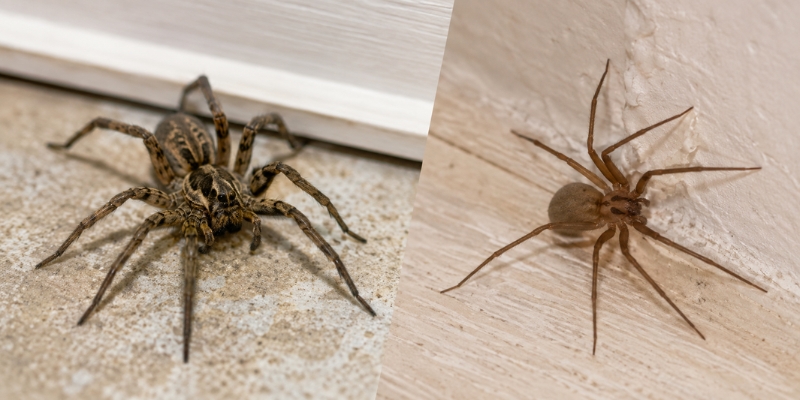
Fort Wayne homeowners who find a large, fast, patterned spider are usually looking at a wolf spider or another hunting spider rather than a brown recluse. Brown recluses are plainer, smaller-bodied, and less common in northern Indiana than farther south. Because color and speed can mislead, Trio Pest Control provides spider identification and control in Fort Wayne when the distinction affects your next step.
The Fast Visual Comparison
Wolf spiders and brown recluses differ in several useful ways:
- Wolf spiders commonly have stripes, mottling, or contrasting markings; brown recluses usually look uniformly tan to brown.
- Wolf spiders tend to appear sturdy and hairy; brown recluses have a smoother, more delicate appearance with fine hairs.
- Wolf spiders have eight eyes in a distinctive arrangement; brown recluses have six eyes in three pairs.
- Wolf spiders may show stronger markings and visible spines; brown recluse legs are generally uniform and lack obvious heavy spines.
- Neither relies on a typical capture web in the open, though a brown recluse makes a small silk retreat in a protected location.
Eye arrangement is important to an expert, but counting eyes on a moving spider is unsafe and impractical. Use overall form, pattern, location, and a clear photograph or secured specimen instead.
Why Wolf Spiders Draw Attention
Wolf spiders hunt on foot. They roam across floors, garages, basements, patios, and landscaping rather than waiting in a prey-catching web. Their speed and size make them startling, particularly when one becomes trapped in a bathtub or runs from beneath a stored item.
Many species have visible stripes or chevrons on the body. Hair and robust legs add to the impression of size. Females may carry an egg sac attached to the spinnerets or carry young on their abdomen, behaviors that distinguish them from a recluse.
A wolf spider indoors may be an occasional invader. Repeated sightings can point to gaps, abundant insect prey, or favorable basement and garage conditions. Evidence such as egg sacs and spiders of different ages offers a clearer indication of indoor breeding.
Why Brown Recluses Are Commonly Misidentified
Fear encourages people to label any brown spider as a recluse. The violin marking receives so much attention that shadows or unrelated markings can look convincing in a blurry photo. Several Indiana species have dark shapes on the front part of the body.
A brown recluse has a plain abdomen and six eyes arranged in pairs. Its body, excluding the legs, is smaller than a dime, and the complete leg span is often around the size of a quarter. Strong stripes, spots, bands, obvious spines, or dense visible hair point toward another spider.
Geography adds context. The Indiana and Ohio Brown Recluse Project reports that brown recluses become less common as one travels north through Indiana. A transported population can survive in a heated building, so Fort Wayne is not impossible territory. Confirmation carries more value here precisely because look-alikes are common and the species is less typical.
Location and Behavior Provide Extra Clues
Wolf spiders often appear in open travel areas at ground level. You may see one running across a garage slab, basement floor, patio, or lawn. They seek prey and shelter and can enter beneath doors or through foundation gaps.
Brown recluses favor dry, quiet, protected spaces. Storage rooms, garages, closets, attics, wall voids, cardboard folds, and seldom-moved belongings provide potential retreats. They roam at night but spend much of the day concealed. A large circular web across a doorway belongs to neither a wolf spider nor a brown recluse.
Finding a location alone cannot confirm a species. Both can occur in garages, and either may fall into a bathtub. Combine the setting with physical characteristics and repeated evidence.
How to Document a Suspicious Spider
Keep your distance and avoid handling it with bare hands. Take several well-lit photographs if you can do so safely, including a top view and an object for scale that does not require moving close. Preserve a specimen intact when practical by placing a container over it and sliding stiff paper underneath.
Write down where and when it was found. Place glue-board monitors along wall edges in storage rooms, garages, and basements, keeping them inaccessible to children and pets. Number and date the traps. Several intact catches can reveal the species and the areas with the most activity.
Crushing a spider can remove the identification features. A distant photo taken through a dusty container can also obscure markings. Professional inspection is useful when you cannot collect clear evidence or when sightings continue.
Reduce Encounters With Either Spider
Repair damaged door sweeps, screens, and appropriate gaps around utility penetrations. Keep vegetation and firewood away from the structure. Reduce insect activity around exterior lights and correct moisture that supports prey in basements or crawl spaces.
Organize storage, use lidded plastic containers, and keep clothing and shoes off the floor. Wear gloves when moving materials that have been undisturbed. Shake out stored footwear and garments before use. Vacuum visible spiders, webs, and egg sacs, then empty the vacuum outside.
These measures reduce shelter, prey, and accidental contact while identification is underway. They also help a technician reach the edges and voids that need inspection.
Let the Evidence Decide the Treatment
Wolf spiders and brown recluses have different patterns of activity, and a treatment plan should reflect the spider actually present. An inspection can evaluate specimens, monitoring results, prey sources, entry points, and harborages. Confirmed brown recluse activity may require broader monitoring of connected indoor spaces; occasional wolf spiders may be addressed mainly through exclusion and exterior conditions.
If you need a confident answer about a spider found in your Fort Wayne home, send Trio Pest Control a service request and arrange an inspection based on the specimen and the property.